Council discusses new industrial waste plans, Sites Reservoir
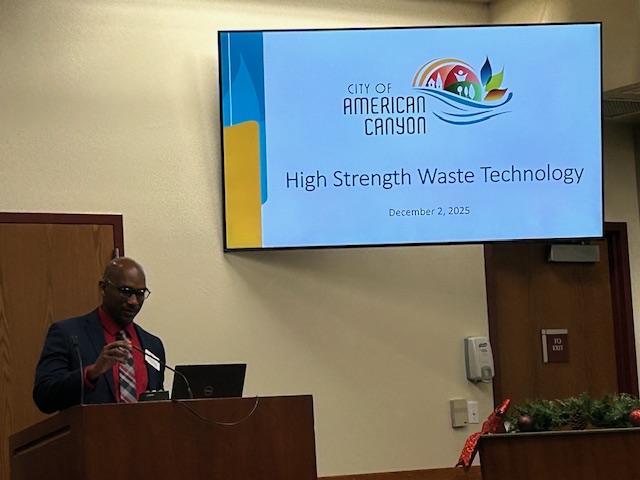
The city of American Canyon plans to invest in a new system to process industrial waste to attract more food and beverage companies to town.
To that end, the city has evaluated membrane technology to build a “high strength waste” system to process the refuse at its wastewater treatment plant.
Pre-screened industrial customers, including wine producers, could eventually dump their liquid waste for a fee in American Canyon without pre-treating it, according to the city.
Instead of investing in a conventional process, the city plans to use anaerobic membrane technology to process industrial wastewater. It requires a smaller footprint than a conventional plant at higher savings.
“It’s a much smaller facility,” Norman Woods, American Canyon assistant director of Public Works, said on Tuesday during a presentation on the project before the American Canyon City Council.
The produced biogas will be harvested and either sold or used to power the plant.
The city’s wastewater treatment plant has used membrane technology since 2002.
It’s not cutting-edge anymore, said Vice Mayor Mark Joseph. “It’s normal and that is why I really think the technological option makes sense, not to mention it’s half the price.”
Woods said the new facility would be built within the footprint of the existing water reclamation plant for about $60 to $70 million. A conventional plant could cost more than $100 million.
Joseph noted the city will not have to deal with land acquisition. That’s “another plus,” he said.
Joseph, a former American Canyon city manager, recalled the city decided on membrane technology years ago in order to obtain a waste discharge permit.
After the meeting, City Manager Jason Holley said the wastewater treatment plant is on 10-15 acres. There is not enough land to build massive ponds for a plant with conventional technology. “And so, we didn’t really have a choice,” Holley said.
Holley said the next steps include how to “deliver” the economic development project, including its financing. The project is meant to address the City Council’s goals to boost the food and beverage industry.
The city’s industrial area along Green Island Road already includes major food and beverage manufacturers such as Mezzetta, Barry Callebaut and Trinchero and Infinity Bottling.
“We already have a food and beverage cluster and we’re trying to have more of them,” Holley said.
American Canyon has houses, a commercial corridor and an industrial area, which offers jobs. It’s good to have a balance, Holley said.
Food and wine producers now either must treat their industrial waste on site or haul it outside Napa County. That’s a burden, Holley said. By removing that burden, the city can make it more likely that wine and food manufacturers will either expand their businesses or relocate to American Canyon.
Wineries in NapaSan’s service area have two options for processing wastewater, said Andrew Damron, general manager at Napa San. They either have to pretreat the waste and discharge it into NapaSan’s sewer system or haul the waste to facilities outside Napa County.
Most wineries truck their wastewater to East Bay Municipal Utility District (EBMUD) in Oakland, Damron said. “EBMUD has excess capacity for trucked wastewater and offers competitive fees,” Damron said.
NapaSan has suspended a pilot program that accepted untreated winery wastewater.
“NapaSan has been operating a pilot program accepting a small volume of trucked winery waste, but this program has been suspended due to impacts to our treatment process,” Damron said. “NapaSan’s treatment plant was designed and built to treat domestic strength wastewater, not high strength industrial wastewater and we don’t have any spare capacity for winery-trucked waste.”
On Tuesday, Jessica Tuteur, president at Infinity Bottling LLC, asked about the timeline of American Canyon’s “high strength waste technology.” Her company now has to haul its waste to EBMUD as NapaSan refuses take it. It costs “a lot of money,” Tuteur said.
Holley said the city will have a financing plan next year, along with an estimated schedule. He anticipated the design would take 12 to 18 months and construction, 24 months. Thirty-six months would be “the most optimistic,” he said.
A Sites Reservoir update
Also on Tuesday, the City Council heard an update on the Sites Reservoir, a $7.8 billion project to be built near the town of Maxwell in Colusa County. American Canyon is one of 30 agencies that have invested in the project. Currently, the city hs no reservoir.
Once built, the Sites will be slightly bigger than Lake Berryessa. Construction is expected to start in 2026 and be completed in 2032, said Phil Brun, a part-time management aide for special projects.
American Canyon primarily relies on the North Bay Aqueduct for water. The water from Sites will reach American Canyon’s water treatment plant via the North Bay Aqueduct.
Federal and state agencies are expected to contribute about $2.2 billion. So, the 30 agencies that are part of the project are expected to pay the other $5.6 billion over 35 to 40 years.
American Canyon’s share is $134 million. So far the city has spent $3.6 million on the project, Holley said.
American Canyon’s City Council voted in 2017 to participate in the Sites Reservoir project.
Tuesday’s presentations on the Sites Reservoir and the “high strength waste technology” were updates. Neither required a city council vote.