City mulls creating an ‘entertainment zone’ at the Ruins
American Canyon may soon create a new entertainment zone around the historic industrial ruins at Watson Ranch, the subdivision under construction east of Highway 29, in an effort to spur business.
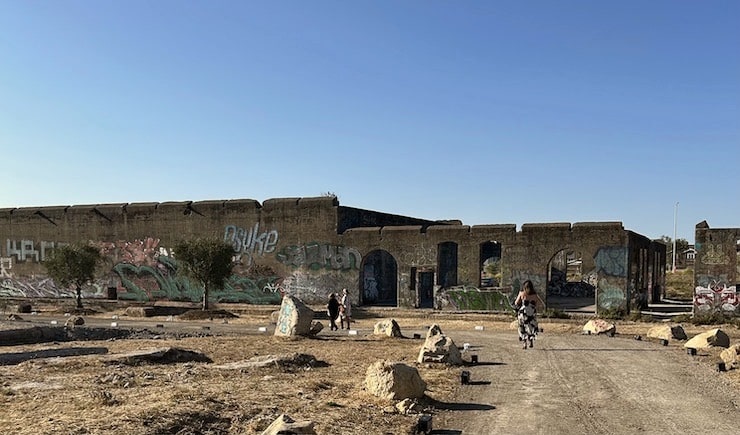
The new zone would allow outside alcohol consumption at the “Napa Valley Ruins and Gardens,” the ruins of the former cement plant initially opened in 1903. The long-abandoned industrial site is part of Watson Ranch, a 300-plus-acre residential and commercial development north of Vintage Ranch.
The new entertainment zone, allowed under a state law that took effect in January 2024, would allow visitors to stroll the grounds with a glass of wine, according to the city.
“I certainly think an entertainment zone is something we should pursue and explore and work with (the) developer to make that happen,” American Canyon Vice Mayor Mark Joseph said Tuesday. “I think it will certainly help the project,” Joseph added, referring to Watson Ranch.
Joseph made a motion to direct staff to come back with an ordinance supporting an entertainment zone. The motion was approved unanimously, 5-0.
To establish the entertainment zone, the city would file an application with the California Department of Alcoholic Beverage Control. The city would also seek feedback public safety agencies.
American Canyon is not the first jurisdiction in Napa County to seek an entertainment zone under a state law that became effective in January 2024.
The Yountville Town Council this summer approved an entertainment zone primarily along Washington Street. Other entertainment zones have been implemented in San Francisco.
These entertainment zones are becoming increasingly popular, American Canyon City Manager Jason Holley told the City Council on Tuesday.
The city, incorporated in 1992, has no city center. Under the city-approved plans, the Napa Valley Ruins and Gardens is to be the “focal point” of Watson Ranch with “festivals, wine tastings, brew pubs, distillery, dining opportunities, hospitality and retail.”
At the same time, the agreement leaves room for “flexibility” to “encourage creative uses and design solutions in the adaptive reuse of the existing [Napa Valley Ruins and Gardens] structures.”
On Tuesday, Watson Ranch developer Terrence McGrath of McGrath Properties, Inc. in Oakland, gave an update on the progress and challenges facing Watson Ranch, a project he began 21 years ago.
McGrath said events at the ruins will continue in 2026, possibly with about 25 to 30 shows in different music genres. “We’re working on the 2026 season right now,” McGrath said. Oakland Symphony’s conductor Kedrick Armstrong has visited the Ruins, McGrath told the City Council.
A series of concerts with Blue Note Napa as the impresario have taken place at the ruins since September.
Social media comments on the shows have been “super positive,” McGrath told the City Council on Tuesday. There have been virtually no reported incidents, he added. About 2,000 people attend each concert, most of whom have never been to American Canyon or Napa County, McGrath said.
However, Blue Note’s future plans in American Canon are unclear. On Wednesday, Blue Note Napa announced it was leaving the Napa Opera House on Main Street after nearly 10 years. Blue Note is now seeking a new venue in the San Francisco area, according to a press release issued Wednesday.
Still, Blue Note said it planned to continue its “partnerships” in the Napa Valley, according to the written statement. Among other projects, it is “exploring expanding upon the success of its new outdoor series at The Ruins in American Canyon, which launched in September with EDM DJ Kaskade.”
In addition to the concerts, McGrath plans to develop a sculpture garden at Watson Ranch. He is seeking to bring in Gaia, a 40-foot-long sculpture of a woman by artist Marco Cochrane. The sculpture is now on top of a building in San Francisco.
The site could also be rented for corporate events.
Watson Ranch’s approved plans include a 200-room hotel, a 3,000-seat amphitheater and smaller one with 800 seats, as well as retail development, projects considered revenue generators for a city. However, these projects have yet to be built.
McGrath, citing market conditions, including the wine industry “recession,” does not plan to build the 200-room hotel anytime soon. Instead, he favors building bungalows, which could be rented at a more moderate price.
Remaining issues include improved access to Highway 29. This would spur house sales, McGrath argued.
The current housing market is terrible, McGrath said. Housing prices are flat; consumers face interest rates that are three times higher than they were five years ago.
Railroad tracks lie along Watson Ranch’s eastern border. City staff recommended the city apply with the California Public Utilities Commission to build a public railroad crossing, possibly at Rio Del Mar East, that would give direct access to Highway 29. However, the City Council took no action Tuesday.
McGrath argued the Rio Del Mar East improvement would take a decade. “I can’t wait 10 years,” he said. Instead, he proposes an interim option: accessing Highway 29 via South Napa Junction, where there is an existing railroad crossing. The City Council made no comment.
Will Carlson, a civil engineer with CBG, addressed the council virtually on behalf of McGrath. Marcus Road at Watson Ranch should be extended north to Watson Lane, he said. Drivers would then take Paoli Loop to reach Highway 29.
So far, six residential projects within Watson Ranch have been approved, totaling 880 housing units, including 186 apartments at Lemos Pointe, according to the city.
Lemos Pointe, an affordable apartment complex, has been completed. In addition, more than 220 houses have been built at Watson Ranch’s “Artisan” and “Harvest” neighborhoods. Another 36 houses are under construction, according to the city.
The developer reported investing $48.5 million on above and underground infrastructure, including $18 million on neighborhood streets.