‘We are the very fabric of this country’: Black History Month honored in American Canyon
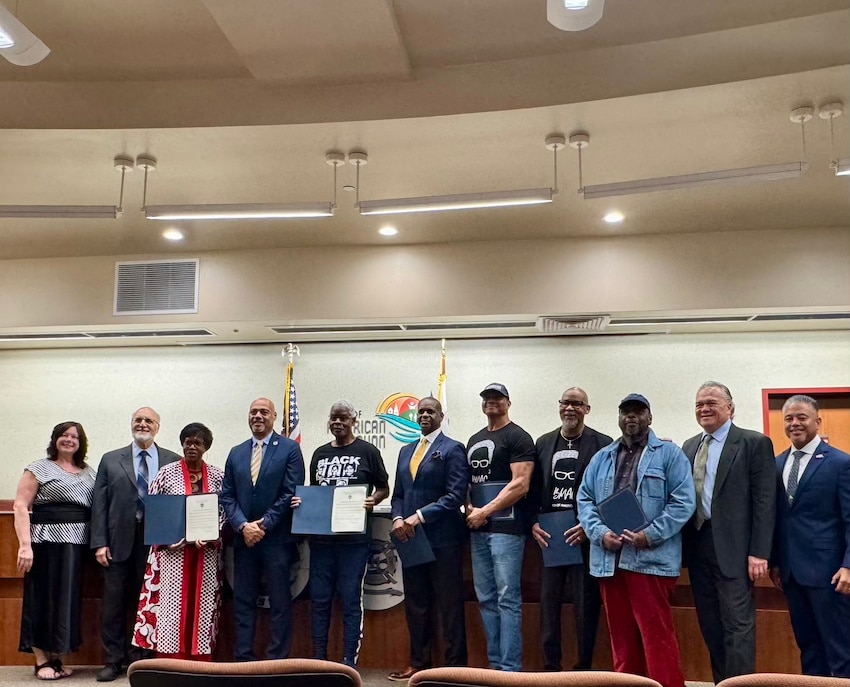
At Tuesday’s city council meeting, American Canyon honored its Black heritage in a ceremony that proclaimed February 2026 Black History Month citywide.
“As the mayor of American Canyon, and as a Black man, the proclamation of Black History Month is deeply important, not as a ceremonial gesture, but as a recognition of history, contribution and responsibility,” Mayor Pierre Washington told the Current.
“My responsibility is to lead a city that is inclusive, honest about its past and intentional about its future. For cities like American Canyon, proclamations affirm to Black residents that their history matters.”
American Canyon has the highest proportion of Black residents in Napa County; 5.2% of the city is Black — that’s some 1,130 individuals in a population of 21,742 people. One of the city’s founding council members and first mayors was Ben Anderson, an African American former Naval officer.
“American Canyon is its own pocket of diversity,” longtime resident Orlando Harris told the Current. “That diversity diminishes substantially once you head [Highway] 29 north.”
Charles Walker, a retired captain for Oakland Fire Department and 30+ year American Canyon resident, started off the night’s speeches along with community organizer Brenda Knight. Knight, a figurehead in American Canyon, helps put together the city’s annual Juneteenth celebration. She came to the ceremony in the midst of caring for her sick mother and grieving for her late husband.
“I’m doing what Black families do,” Knight said. “I’m doing what we do when it’s time for us to take care of our families: We step up.”
Speaking to the room, Orlando Harris said: “We are the very fabric of this country. We, Black Americans — and that’s Black with a capital ‘B’ — made sure that civil rights progressed.”
Harris, a retired U.S. Army officer, added that right now, that fabric is threatened by the Trump administration’s efforts to roll back decades of struggle for civil rights for Black Americans, which in turn buoyed the rights of all people across the U.S.
Black innovations in medicine, art, culture, finance and technology have shaped life in America since the country’s inception, said Harris. And that legacy is continuing.
“We wanted to be here, Black men of American Canyon, to represent and to show that we are here, and we’re making a positive contribution to this city,” he said to applause.
Harris’ daughter, Dr. Danielle Harris, was the first student from American Canyon High School to attend an Ivy League university. Harris’ family comes from Alabama; his third cousin is civil rights activist Rosa Parks, who refused to give up her bus seat for a white passenger in 1955, setting in motion the historic Montgomery bus boycott.
Former American Canyon City Council member Kenneth Leary walked up to the podium and stood in silence, facing listeners for 10 full seconds, the kind of pause that brings the room’s attention to sharp focus. He walked off without a word.
The 10 seconds were partly to acknowledge “what has been done to these people, to my people,” he said later. “Our voices will not be silenced. Our history will not be silenced.”
Leary moved to American Canyon in 2003. He is currently a commissioner with Napa’s Local Agency Formation Commission (LAFCO) and was a member of the city council from 2012 to 2020.
“Public service, for me, is life,” he said. “Community is the most important thing to our survival. And I will continue to work to build community and build it from my people outward.”
Being Black in Napa is not without its challenges, Leary said. He remembered driving up Highway 29 from American Canyon years back. “Highway Patrol followed me all the way to Yountville. I pulled in to park and got out. They just watched me and then took off,” Leary said.
“American Canyon is looked down on by people in Napa,” he added.
Harris agreed, noting that when his kids were high schoolers growing up in American Canyon, they told him: “Dad, you know they call us the projects, right?”
“We’ve still got a lot of work to do,” Harris said.