Down a garden rabbit hole: prevent fungi that creates work
Last year I was fired up with the urge to clean out my junk shed and turn it into my tool shed. I marched to the southwest corner of my yard and promptly fell, thigh deep, into a hole that opened beneath me. It didn’t take me long to realize what had prompted this new landscape feature.
Some years ago, I had noticed a strange growth on the trunk of my curly willow tree. It looked as if elves had decided to attach round wooden shelves to the tree. I told my husband it was a Ganoderma fungus (Ganoderma lucidum) and it meant the tree was dead.
“But it has leaves on it!” he said. I answered, “Not for long. That tree will eventually fail. The fungus is a sign the prognosis is terminal.”
He didn’t believe me, even when I reminded him that I was, ahem, a UC Master Gardener. So, we called in our local arborist to confirm my thesis. He said, yes, I was correct, and the tree needed to go.
This tree was at least 40 years old, so it was nearing the end of its life anyway. Willows are not long-lived like oak trees.
Ganodermafungus is an opportunistic disease. It can enter through infected soil or a wound in the tree. I thought back to when I first moved in and decided to hang my rope hammock between the two willow trees. Squirrels chewed through the rope within 24 hours. I was left with two holes in two tree trunks, and yes, the second willow eventually failed, too.
When the arborist told me the tree had to come out, I did not appreciate the shades of meaning. I translated “come out” as “cut down.” That was incorrect. I should have interpreted it as if I were a dentist.
The tree was cut down and hauled away, but the trunk and roots remained. They continued to be attacked by the fungus until they were degraded, and the soil lost its structure. All that remained was for a portly gardener to enact the opening scene of Alice’s Adventures in Wonderland and fall down the rabbit hole.
I should have had the trunk and roots ripped out and hauled to the dump. The detritus from a tree with a fungal infection should go to a landfill, not a compost pile, and the soil should be disinfected, fumigated, solarized or removed.
Since chemical fumigation can hurt beneficial soil organisms, and there isn’t enough sun in my yard to solarize anything, I can either hire someone to remove the soil or do it myself with my Christmas present—a set of shiny new digging, gouging and chopping tools from Wheeling, West Virginia.
I have learned a lot about Ganoderma. It is a scourge in Asia, where it kills palm oil trees. Palm oil is a multi-billion-dollar business, so that’s serious damage. In North America, it attacks hardwood trees, such as oaks.
The visible part of the fungus is the shelf-like protuberance. The fungus doesn’t have gills but is smooth and hard. It may have a dusty brown powder on it that can cause an allergic reaction in some people, so wear gloves when handling it.
However, most of the damage is inside the tree. Ganoderma is both a saprocyte (feeding on dead wood) and parasite (killing its living host). It breaks down cellulose and helps trees rot. You see Ganoderma everywhere on forest walks, and it has its purpose, such as providing animal habitat. However, it becomes a problem when it affects food crops.
I wondered if anything would grow in that soil or if I have to remove it this spring. Planting shrubs or flowers seems acceptable because you can pull them out if they get sick, but do not plant a tree in soil that you know hosts Ganoderma. Especially not a palm tree. Also avoid planting potatoes or strawberries in infected soil. (That was never an option for me because there isn’t enough sun in that part of my yard.)
I do have vegetation flourishing in that spot, probably because the fungus has made the soil more acidic. A camellia is doing well. So is an enormous borage plant. The ivy is bushier than ever. Volunteer yellow plums are successful, and there is a carpet of moss.
And of course, one plant is ready to take over the yard, same as ever. The yearly battle with wild onion—my own private Iliad—will continue. Nothing inhibits it.
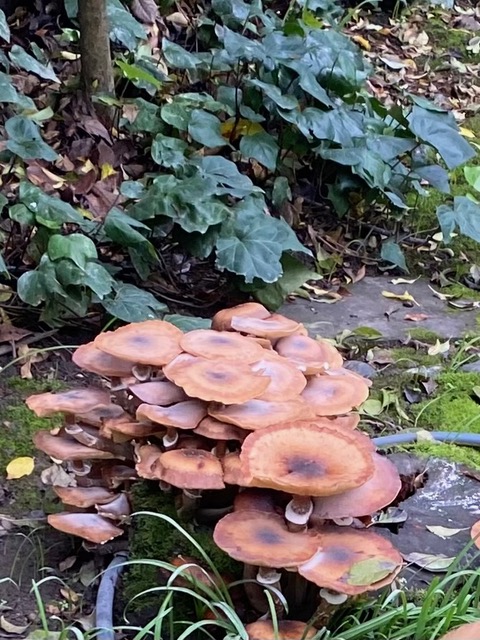
A few weeks ago, my son-in-law came in to tell me that there were mushrooms all over the back corner of my yard. I ran out to remove them before the baby ate them. They were about four inches wide, flat, with a medium brown rim. I used the plant identification tool on my phone (iNaturalist) to identify them. They are honey mushrooms (Armillaria mellea), and they are growing out of the first willow trunk.
Like Ganoderma, honey mushrooms don’t cause much trouble in the wild but are a problem in the cultivated landscape. Roses and hydrangeas are particularly vulnerable. Fortunately, some of my favorite plants—honeysuckle, lavender, salvia—are resistant to the honey mushroom. It spreads by sending out rhizomes underground. They could have been in the soil for years.
Are they edible? Yes, if they are boiled before cooking, and no, I am not eating them. Always check and double-check your mushroom identification, consulting several sources. Honey mushrooms grown near buckeyes or hemlocks can cause upset stomachs.
It looks as if I have some work to do this spring. How does one avoid accumulating excess fungi in one’s yard? First, fertilize your plants and water them appropriately to keep them in peak condition and resistant to fungi. Remove dead wood. Avoid root and bark damage and soil compaction. Don’t prune in wet weather. Very important: have good drainage. Prevention is easier than restoration.
Workshop: Join UC Master Gardeners of Napa County for a workshop on “Winter Rose Care” on Saturday, Jan. 10, from 10 a.m. to noon, via Zoom. The workshop will highlight pruning techniques for all rose types, along with everything needed to make your roses a success. Reserve here to receive the Zoom link.
Workshop: Join UC Master Gardeners of Napa County for a workshop on “Starting Your Own Vegetable Seedlings” on Saturday, Jan. 10, from 2 to 4 p.m., at UC Cooperative Extension, 1710 Soscol Ave., Napa. We’ll cover all the basics, including proper moisture, temperature and light for successful seed starting, and care of seedlings until they are ready for transplant. We provide some seeds, containers and soil; bring your own seeds if you like. Reserve here.
Workshop: Join UC Master Gardeners of Napa County for a workshop on “Winter Fruit Tree Care” on Saturday, Jan. 24, from 3 to 5 p.m., at UC Cooperative Extension, 1710 Soscol Ave., Napa. Tackling dormant season tasks will reward you with bigger and better fruit this summer. Learn about pruning techniques, dormant sprays and how to plant a bare-root tree. Attendees will be invited to a hands-on pruning session at a future date. Reserve here.
Help Desk: The Master Gardener Help Desk is available to answer gardening questions. Use the online Plant Problem Help Form or email us at mastergardeners@countyofnapa.org. Include your name, address, phone number and a brief description of the problem. Visit in person on Mondays and Fridays from 10 a.m. until 1 p.m. at the UC Cooperative Extension Office, 1710 Soscol Ave., Suite 4, Napa.